Hello World
Why we're starting Marker.
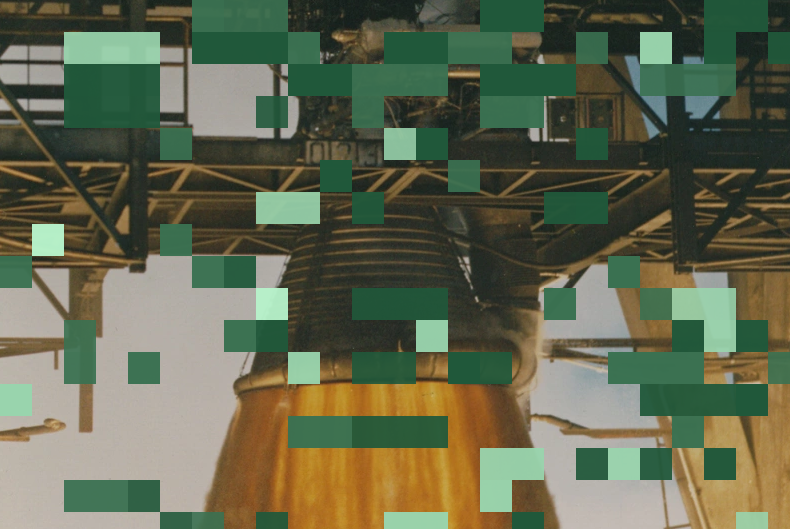
In the early 1960s, to prove the F-1 rocket engine wouldn’t shake itself apart on the way to the Moon, Rocketdyne engineers put bombs inside it.
Combustion instability had been destroying engines on the test stand for years. The fix was not drawing up a cleverer design: it was a test.
Detonate a charge inside the chamber mid-burn and if the engine could swallow the explosion in a fraction of a second, it passed. They ran that gauntlet until instability had nowhere left to hide. When the first Saturn V flew in November 1967, every stage succeeded live on the first try, and it worked because the ground testing had been merciless enough to earn it.
The world we trust is built this way. I came up through nanoengineering and medical device research where a single dust particle ruins a wafer. Richard Feynman is credited as the godfather of nanoscience. A couple years back I found a quote he had said about the Challenger disaster that I feel applies to all safety-critical technology:
“For a successful technology, reality must take precedence over public relations, for nature cannot be fooled.”1
In AI terms: demos, claims, and benchmark scores do not matter if the system fails in production. Testing is what turns an invention into infrastructure.
Breaking things for a living
I spent years in the autonomous vehicle industry. My honest job description was: break things before the world does. Zoox went straight at the hardest problem: Level 5 autonomous urban point-to-point transportation of humans. The theory is that if that can be solved, then package delivery or suburban transport will be addressable with the same technology.
That left me with a conviction to build testing discipline on the most safety-critical version of problems. If your voice agent safely handles legal questions and SSNs, the same stack can likely be trusted to take a pizza order.
The gap
When I left AVs to build voice AI, I expected the hard part to be the agents, but it was knowing whether they worked. Voice is audio, telephony, interruptions, accents, latency, and a model that answers differently every time you call it.
Pieces exist for testing but are largely unconnected. Simulations here, transcripts there, a judge prompt someone tuned once and never versioned. Despite the shift to improvement loops, if context leaks at the seams, agent quality slips.
Marker closes these gaps. An operating system for voice agents built on tightly connected primitives. Every simulation, transcript, judgment, and fix carries its full context and version history. Every piece is native to both AI and human operators. Everything is configurable, durable, and plugs into whatever stack you already run, wherever you run it.
Why “Marker”
A marker is a primitive: the surveyor’s stake, the trail flag, the small durable thing you place so you can find your way back. That’s what verification evidence should be.
But a marker is also a creative instrument, the thing you sketch and iterate with as you form your ideas. We wanted to capture the essence of evidence and authorship in one word.
Voice is the future of how people interface with software. This future doesn’t arrive because demos get better. It arrives when it is safe to fail: a place where an agent can blow up a thousand times on the test stand so it never blows up in production. Rocketdyne got to the Moon by bombing its own engines. We want to hand you a platform where you can place bombs within your voice agent.
If you want the ultimate safety infrastructure for your agents, we’re building it at usemarker.ai. Say hello.
Test as you fly, and fly as you test.
— NASA systems-engineering principle
- Richard P. Feynman, “Personal Observations on the Reliability of the Shuttle,” Appendix F to the Rogers Commission Report, 1986. nasa.gov/history/rogersrep/v2appf.htm
- Cover photo: “The F-1 Rocket Engine” by Michael Weber, DVIDS, Story ID 480255, taken 09.06.2024. Public domain. This work, identified by DVIDS, must comply with the restrictions shown on dvidshub.net/about/copyright.